
There is a moment at every trade show that happens before anyone arrives.
The crate lands. Somebody in a safety vest wheels it into a rectangle of tape on a concrete floor, and for about an hour the whole thing looks like a mistake. No walls yet. A pile of anonymous boxes. One very tired person holding a rigging plan and a coffee that went cold in a previous country.
I have stood in that hour on three continents. It is my favorite part of the job and I understand how strange that sounds.
Here is what took me years to understand about it. By the time the crate lands, most of the decisions that will decide whether the show works have already been made. Not by you. By the people who will walk that floor in two days, currently sitting at home in a different time zone, typing questions into a chat window in their kitchen.
In its 2025 Buyer Experience Report, 6sense found that buyers placed four of the five vendors they would evaluate on their shortlist on day one. They ultimately bought from that original shortlist ninety five percent of the time.
Read that finding carefully and you get the uncomfortable truth of modern tech events.
The show is not where you get discovered. It is where you get confirmed or eliminated.
That is not a reason to stop exhibiting. It is a reason to be much clearer about the job the floor is meant to do.
People are not walking away from the floor. They are walking onto it with different expectations, and a lot of teams have not updated the playbook.
So here is mine. Four parts. Built from eight years of standing in booths for ten hours a day, plus the research I went and checked afterward to see whether the thing I felt was actually true.
A note on qualifications, because somebody always asks. I cannot write the code. I am not going to architect your deployment or read your network diagram and pretend I enjoyed it. What I can do is tell you what a stranger hears when you explain your product, because I watched several hundred strangers a day do exactly that, and their faces do not lie the way survey responses do.
That turns out to be the whole job.
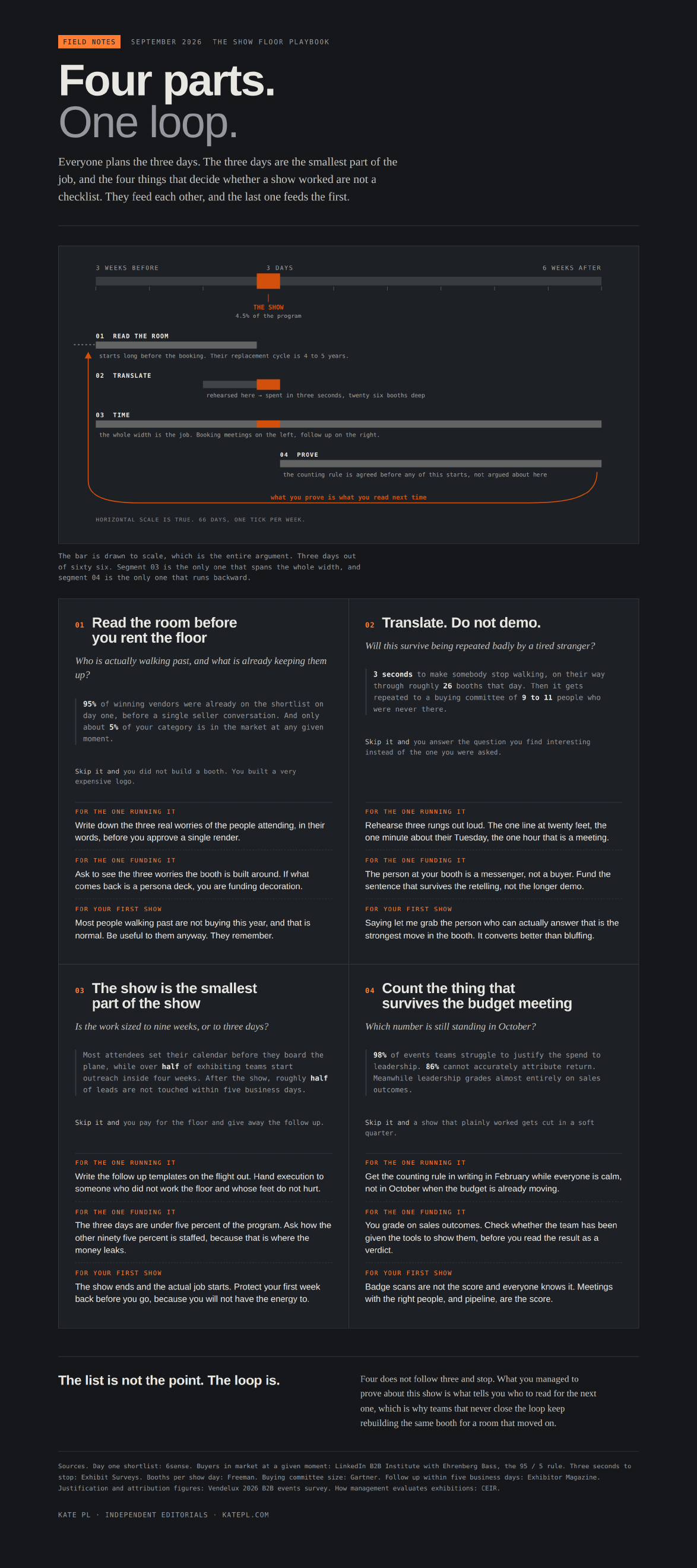
One. Learn the room before you rent the floor
Most booth planning starts with the wrong question. It starts with what do we want to show. It should start with who is walking past and what are they already worried about.
The floor is not one audience. It is at least three, and they need completely different things from you.
There is the small group who are actively buying right now. LinkedIn’s B2B Institute, drawing on research from the Ehrenberg-Bass Institute, popularized the 95-5 rule as a planning principle: most potential B2B buyers are out of market at any given time. That math does not pause because you paid for a corner booth.
There is a much larger group who are not buying this year but will be buying eventually, and whose only job at this show is to build a mental list for later.
And there is a group who will never buy from you and are wonderful anyway, because they will tell you the truth about your category for free.
The useful part is that all three groups can teach you something. The room contains current demand, future demand, and category intelligence—if your team knows which conversation it is having.
What this changes in practice is what you are optimizing for. If you build your booth exclusively for the five percent who are buying now, you build a sales counter, and the other ninety five percent walk past it because nobody enjoys being sold to in a hallway. If you build it exclusively for brand memory, your sales team will quietly hate you by day two and they will be right.
You need both jobs running at once, and you need to know which conversation you are in within the first thirty seconds.
The move: before you approve a single render, write down the three most common worries of the people who will actually attend. Not the personas from the deck. The worries. Then look at your booth and ask whether a person carrying that worry would recognize themselves in it from twenty feet away.
If the answer is no, you did not build a booth. You built a very expensive logo.
Two. Translate, do not demo
Attention on a show floor is short, crowded, and competitive. Now add the part almost nobody plans for: the person in front of you is often one member of a larger buying group, not the only person who decides.
They are the messenger.
Everything you say to them will be repeated, badly, on a Tuesday, in a conference room you will never see, to people who did not attend and are not inclined to be impressed. Your pitch does not have to survive the booth. It has to survive being paraphrased by a tired person from memory.
This is exactly the point where being deeply technical starts working against you. Once you truly know a system, you lose the ability to hear it the way a stranger hears it. You start answering the question you find interesting rather than the one you were asked. I have watched brilliant engineers do this at full speed while a genuinely qualified buyer nodded politely and slid toward the aisle.
The person who has not lost that ear is the translator. That is the role, and it is worth more on a show floor than another product certificate.
Vendelux’s read on 2026 buyer conversations shows the questions have already shifted. Buyers used to ask what does this do. Now they arrive asking what is the return compared to the platform we already pay for, and they ask about data privacy and certifications during discovery instead of at the end. Nobody is stopping at your booth to be educated about the category. They want to know why you and not the two other names already on their list.
The move: build a ladder with three rungs and rehearse all three.
The one line, which has to work at twenty feet and be repeatable by a stranger. The one minute, which connects your thing to their Tuesday problem and names the alternative they are already using. The one hour, which is a meeting, not a booth conversation, and which you should be trying to schedule rather than deliver standing up.
Then teach every single person in that booth the handoff. Knowing when to say let me get the person who can actually answer that is not a weakness. It is the highest form of booth competence there is, and it converts.
Three. The show is the smallest part of the show
The floor is three days. The work is about nine weeks.
Vendelux’s 2026 B2B Events Survey found that fifty five percent of teams started outreach less than four weeks before an event—well behind the eight-to-twelve-week cadence it associates with stronger programs.
The other end is worse. The pattern at a discouraging number of companies is this. Spend six figures. Ship a crate across an ocean. Stand for thirty hours. Collect a spreadsheet. Get back, find four hundred unread emails and a quarterly review, and touch that spreadsheet nine days later when the moment has cooled to room temperature.
I have been that person. Not proudly. It is not laziness, it is physics. The show consumes everyone who works it, and the recovery window lands exactly when the leads are hottest.
The fix is not working harder in the week after. The fix is deciding, before you leave, what happens in the seventy two hours after you land, and staffing it with people who were not on the floor.
This is also, incidentally, where AI is genuinely useful rather than decoratively useful. The most credible near-term case is not a chatbot in your booth. It is summarizing, sorting, and drafting the follow up so the human touch lands while the conversation is still warm in somebody’s head.
The move: three weeks before, six weeks after. Book meetings ahead instead of hoping for traffic. Write the follow up templates on the plane out, not the plane home. Assign the follow up to somebody whose feet do not hurt.
Four. Count the thing that survives the budget meeting
Here is the number that should worry everybody in this industry.
In Vendelux’s 2026 B2B Events Report, ninety eight percent of teams said they struggle to justify event spend to leadership. Eighty six percent said they struggle to attribute ROI accurately to events. Ninety percent said event-influenced deals go unattributed in their CRM.
Leadership still expects commercial evidence: qualified meetings, pipeline contribution, and revenue impact—not a badge-scan total presented as though every scan means the same thing.
Put that together and you get the defining tension of the job. The people signing the check judge events on sales outcomes, and the people running events largely cannot prove those outcomes with the systems they have.
That gap is why event budgets get cut in a soft quarter even when the events worked. Not because leadership is hostile. Because the story arrives without a number attached, and a story without a number loses to a spreadsheet every time.
The teams handling this well have made two changes.
First, they consolidated. Vendelux’s 2026 analysis found concentrated programs of five to ten events outperforming portfolios of fifteen to twenty five events with flat budget allocation. Fewer shows, deeper presence, actual staff at each. This is much harder than it sounds, because every event on that list has an internal sponsor who will take its removal personally.
Second, they changed the unit of measurement. Badge scans are a vanity metric and everybody knows it. The number that survives scrutiny is meetings with people who actually fit your buyer profile, plus pipeline the event sourced or influenced, tracked with a rule you agreed to in writing before the show rather than argued about after.
The move: pick the number before you pick the booth. Get finance and sales to sign off on how it will be counted while everyone is still calm. Then be willing to cut the event that has been on the list for six years because it is on the list.
The part the machines are not getting
I want to be careful here, because it would be easy to end this with a line about how nothing replaces the human touch, and that sentence has been printed on so many conference tote bags that it means nothing.
So let me be specific instead.
Buyers are doing more of their evaluation privately than at any point in this industry’s history. They arrive with a shortlist assembled by tools you cannot see, from sources you did not choose, holding opinions about you formed by something that has never used your product. Attribution catches a fraction of that journey. The rest happens in the dark and always did, only now the dark is bigger and faster.
What remains, and what I do not think gets automated soon, is the moment somebody stands in front of you and their face does something their words do not.
The flicker when you name a problem they have not admitted to their own team. The pause before they say we are probably fine with what we have. The way a person leans back when they stop being sold to and start actually thinking.
I spent eight years reading that. It taught me more about where a category was going than any report I have read since, and it is available to anyone willing to stand there and pay attention instead of reciting.
That is the whole playbook, honestly. Know who is really in the room. Say it in a sentence that survives being repeated. Do the work on both sides of the three days. Count something a CFO will respect.
And then look up from your badge scanner, because the most valuable thing on that floor has never once been in the lead export.
Kate PL writes about careers, technology, and what actually happens behind the polished recap.